3D & SimulationSurface Operators
Texture Displace
Displaces by a wired texture's luminance, or by its RGB as a vector.
The Texture Displace deformer reads a picture as a height or vector map.
- Amount, Displace Mode, Fit
- Found in the node graph under Surfaces → Deformers
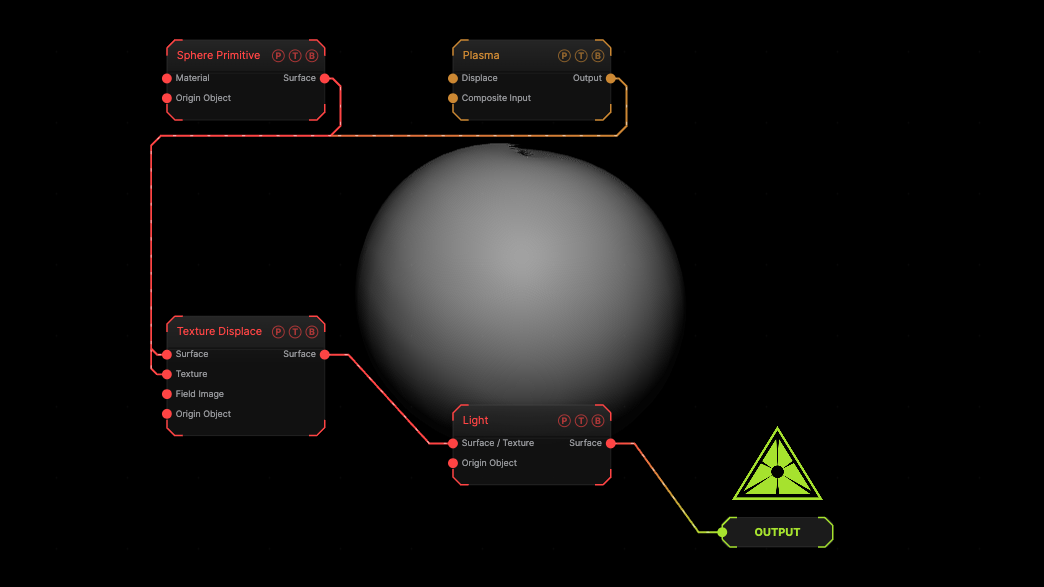
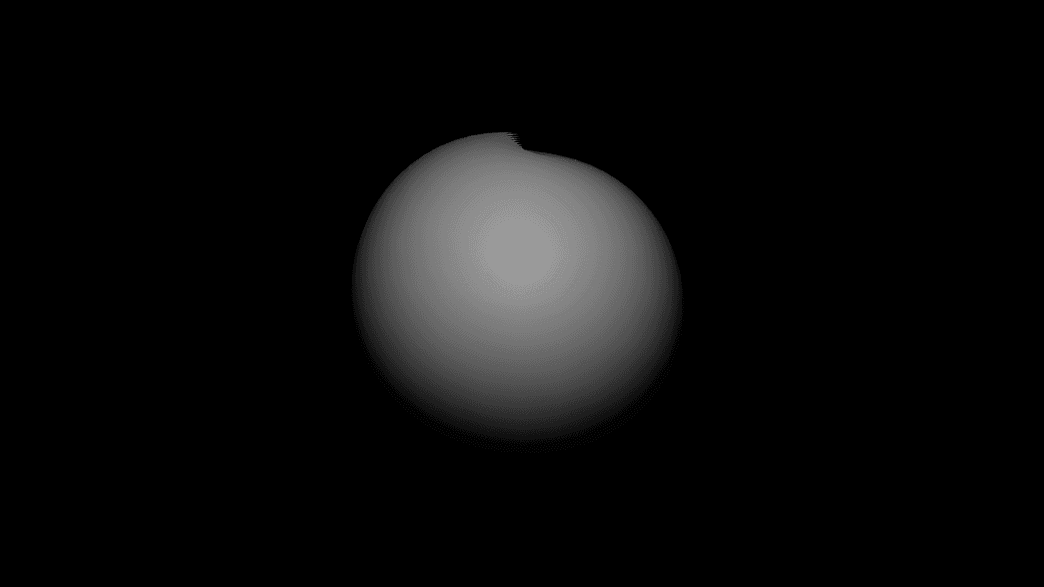
The image on the right is the example patch itself. Drag and drop it onto the app, or load it with File → Load, to open the full graph. A Plasma generator displacing a subdivided sphere.
Inputs and outputs
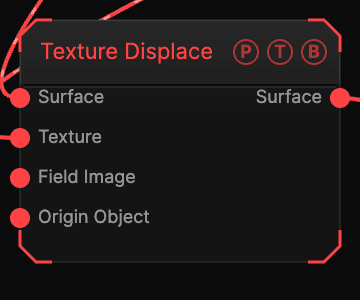
| Port | Type | Purpose |
|---|---|---|
| Surface | Surface | The mesh to deform. |
| Texture | Texture | The map. |
| Field Image | Texture | A texture read by the Image field shape. |
| Origin Object | Surface | A Null to parent to. |
| Surface | Surface | The deformed mesh. |
Parameters
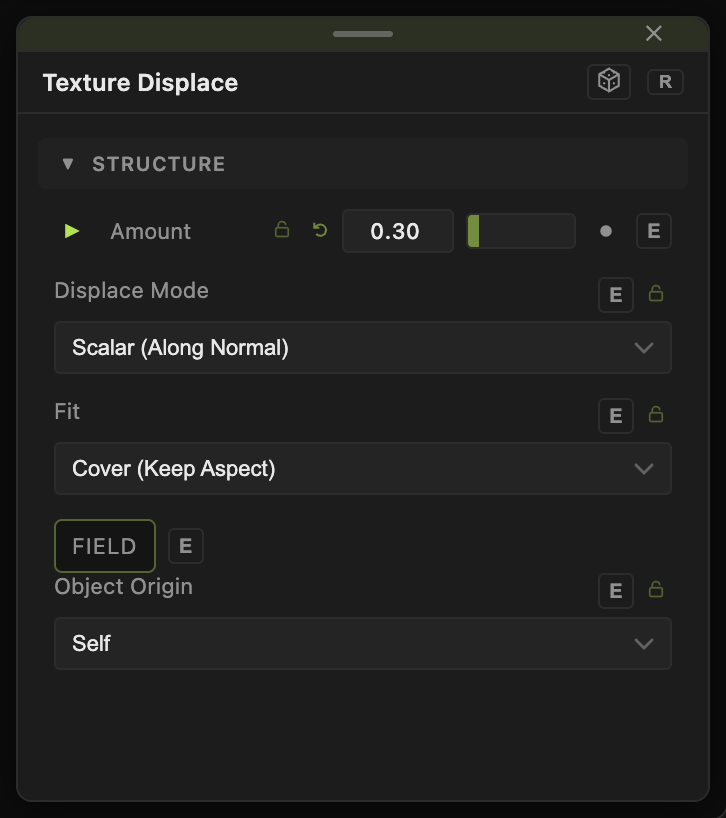
- Amount (−3 to 3, default 0.3).
- Displace Mode — Scalar (Along Normal) (default) or Vector (RGB → XYZ).
- Fit — Cover (Keep Aspect) (default) or Stretch (Match Material Maps).
Field
- Field (default off) — limits the deformer to a region. Field Shape (Sphere, Box, Plane, Image), Field Size, Falloff, Inner Radius, Invert Field, Field Follows Mouse, Image Channel, and the Field Position / Heading / Pitch / Roll / Scale block.
- Position X / Y / Z, Rotate Heading / Pitch / Roll, Scale X / Y / Z, Uniform Scale — the deformer's own frame, which sets its axis.
Every slider has a per-parameter animation bar, so it can be animated, audio driven, or MIDI mapped.
Examples
Relief — a Topographic generator on a subdivided Plane.
Troubleshooting
It does nothing — the wire must land on the main Surface input, not a side port, and the mesh needs enough vertices. Raise the Primitive's Subdivision.