Voronoi
Cellular noise generator that divides space into organic regions with configurable distance metric, edge detection, and border width.
The Voronoi node generates cellular noise: space is partitioned into regions around a set of drifting seed points, each cell shaded by its distance to the nearest point. It produces stained-glass, cobblestone, and cracked-surface looks, and its edges can be isolated for a wireframe.
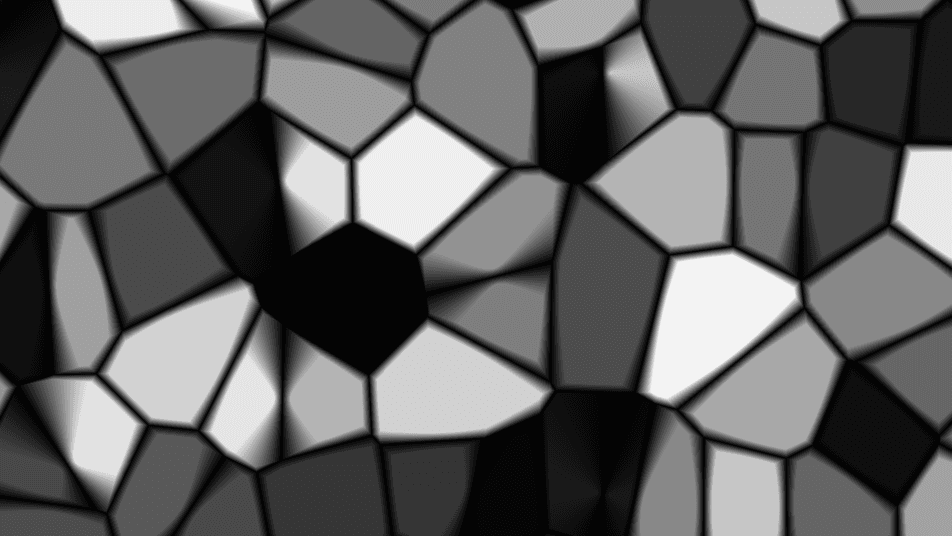
- One texture output; two optional texture inputs (domain warp and composite)
- Distance Metric, Edge Detect, and Border Width shape the cells
- The cells drift over time when animation is playing
- Found in the node graph under Generators as Voronoi
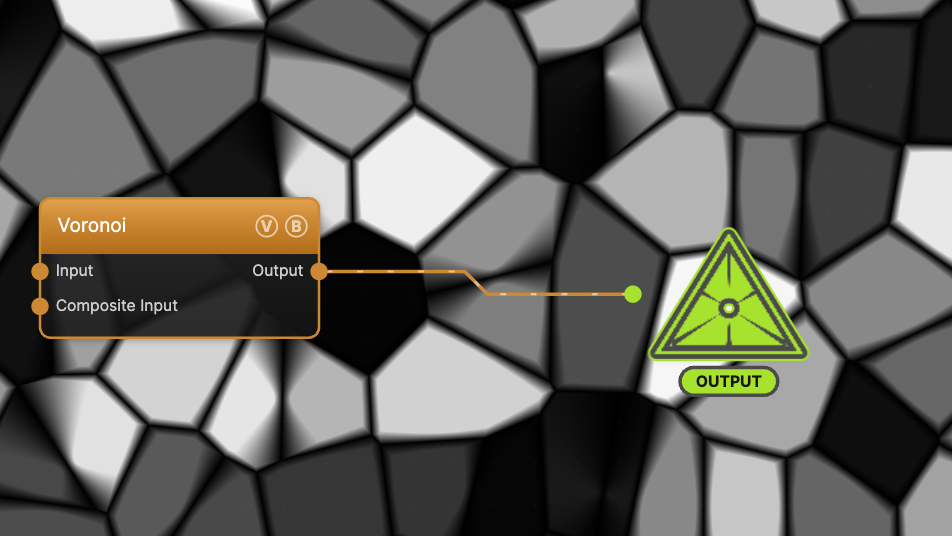
The image on the right is the example patch itself — drag and drop it onto the app (or load it with File → Load) to open the full graph.
Inputs and outputs
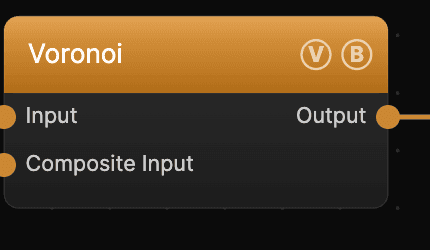
| Port | Type | Purpose |
|---|---|---|
| Displace | Texture | Domain warp: the red and green channels push the sample coordinates by Displace Amount |
| Composite Input | Texture | Composited under the output with Composite Mode and Composite Mix, which appear once the port is wired |
| Output | Texture | The grayscale cell field, normalized to 0–1 |
A black (or disconnected) Input produces no warp; the warp strength scales with Scale.
Parameters
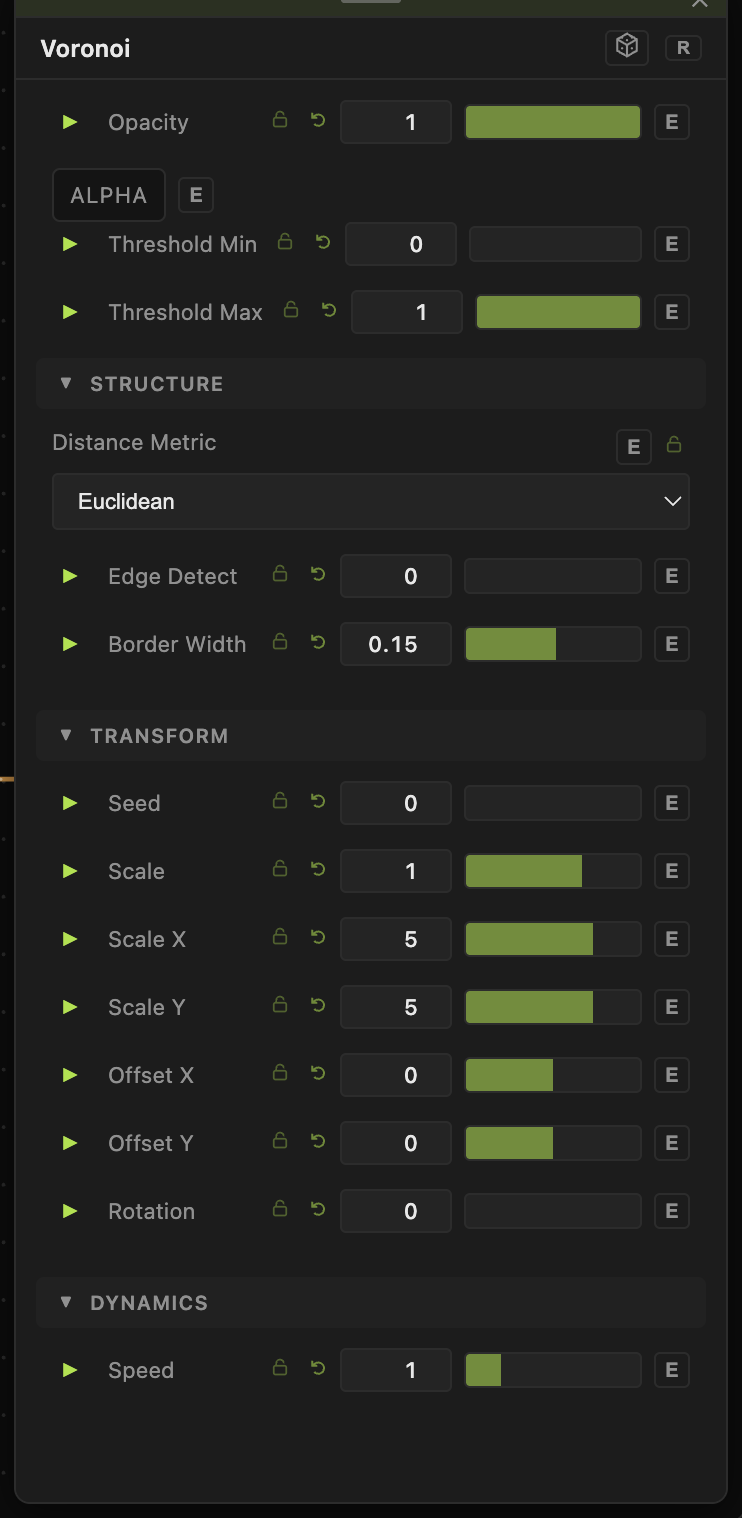
Opacity, Blend Mode, ALPHA, Invert Alpha, Threshold Min / Threshold Max — the standard operator header; see Perlin Noise for details.
Structure
- Distance Metric — how distance to the nearest seed point is measured. Euclidean (default) gives straight, angled cell edges; Manhattan gives blocky, axis-aligned cells; Chebyshev gives square, tile-like cells.
- Edge Detect (0–1, default 0) — blends the fill toward edges only. At 0 the cells are shaded by distance; raise it to isolate the borders as bright lines on dark for a wireframe.
- Border Width (default 0.15) — the thickness of the dark seams between cells. Higher values widen the gaps; negative values invert the seam.
Transform
- Seed (0–99999), Scale (0.01–10, default 1), Scale X / Scale Y (0.01–50, default 5), Offset X / Offset Y (−20 to 20), Rotation (0–360) — the shared generator transform block. Scale sets how many cells fill the frame.
Dynamics
- Speed (0–5, default 1) — playback rate multiplier for the cell drift, compounding with the global animation speed. 0 freezes the cells.
Every slider has a per-parameter animation bar, so any of these can be animated, audio-driven, or MIDI-mapped — see Parameters and Controls.
Troubleshooting
Cells don't move — the node's Speed is 0, or global animation is paused in the transport bar.
Only borders show, no fill — Edge Detect is raised; lower it to bring back the distance shading.
Cells look muddy — raise Border Width to separate them, or increase Threshold Max contrast.