FBM
Fractal Brownian Motion generator that layers multiple octaves of noise into rich, detailed grayscale patterns.
The FBM node generates Fractal Brownian Motion — it sums several octaves of noise, each at a higher frequency and lower amplitude than the last, adding the raw value of every octave. The result is a balanced, natural-looking field with detail at multiple scales. It is the general-purpose fractal noise for terrain, clouds, and surface texture.

- One texture output; two optional texture inputs (domain warp and composite)
- Fractal controls (Octaves, Persistence, Lacunarity) plus a Noise Type base selector
- The base octave can be Perlin, Simplex, or Voronoi
- Found in the node graph under Generators as FBM
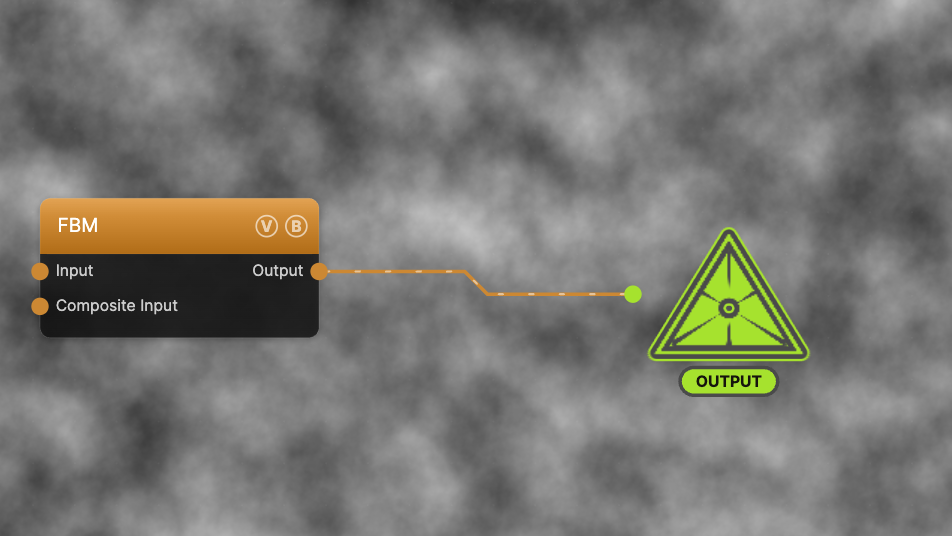
The image on the right is the example patch itself — drag and drop it onto the app (or load it with File → Load) to open the full graph.
Inputs and outputs
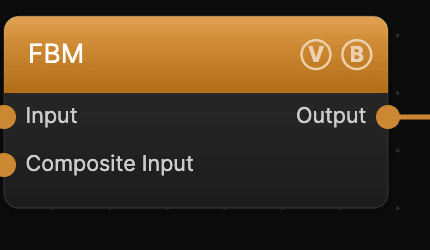
| Port | Type | Purpose |
|---|---|---|
| Displace | Texture | Domain warp: the red and green channels push the sample coordinates by Displace Amount |
| Composite Input | Texture | Composited under the output with Composite Mode and Composite Mix, which appear once the port is wired |
| Output | Texture | The grayscale noise field, normalized to 0–1 |
A black (or disconnected) Input produces no warp; the warp strength scales with Scale.
Parameters
The field is sampled with time on a third axis, so animation evolves the pattern in place rather than scrolling it.
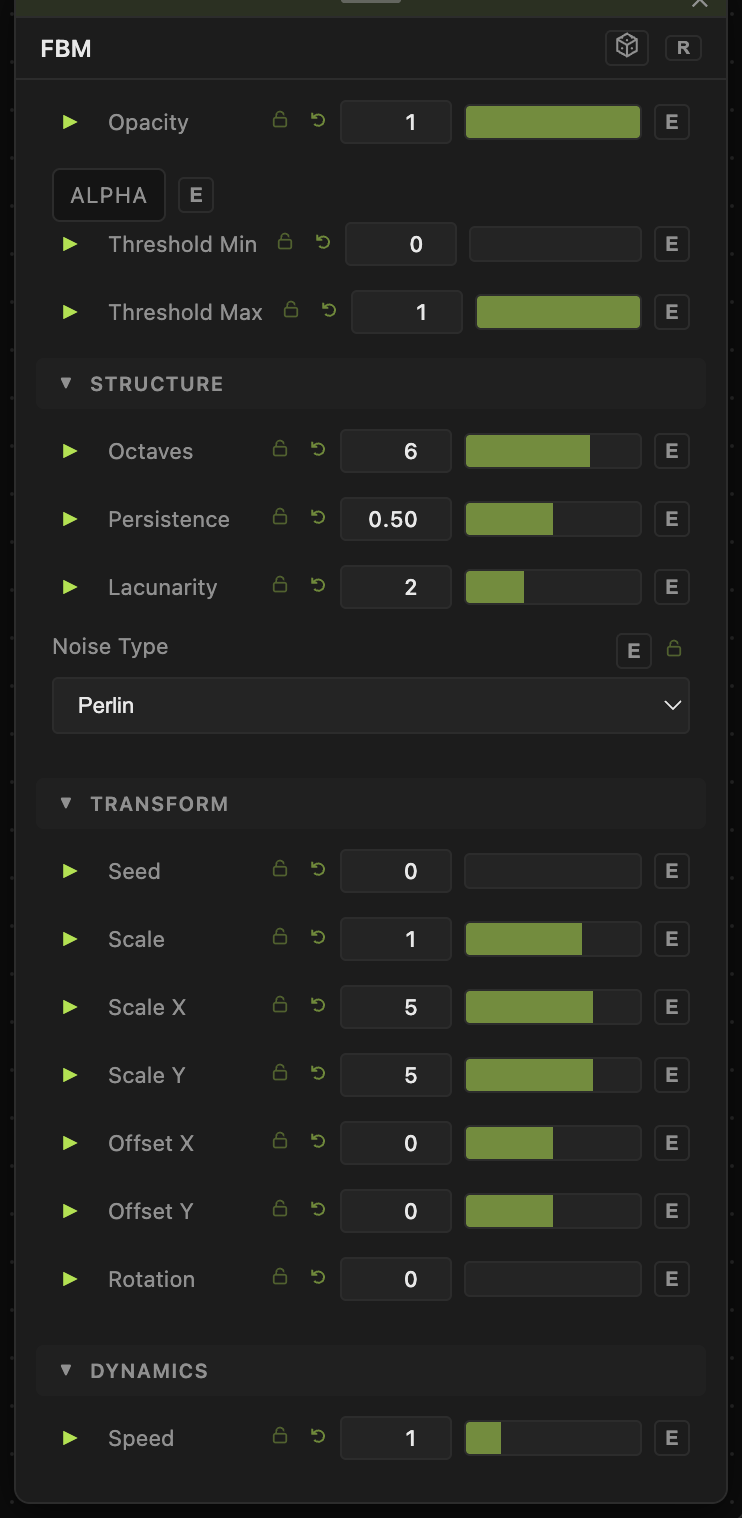
Opacity, Blend Mode, ALPHA, Invert Alpha, Threshold Min / Threshold Max — the standard operator header; see Perlin Noise for details.
Structure
- Octaves (1–8, default 6) — how many noise layers stack. Each octave adds finer detail; more octaves means a busier, more detailed texture at higher cost.
- Persistence (0–1, default 0.5) — how much each successive octave contributes. Higher values keep the fine octaves loud, making the texture grittier; lower values leave only the broad shapes.
- Lacunarity (1–4, default 2) — the frequency multiplier between octaves. Higher values space the detail scales further apart.
- Noise Type — the base noise each octave is built from: Perlin (default), Simplex, or Voronoi. Voronoi gives the octaves a cellular character rather than smooth gradients.
Transform
- Seed (0–99999), Scale (0.01–10, default 1), Scale X / Scale Y (0.01–50, default 5), Offset X / Offset Y (−20 to 20), Rotation (0–360) — the shared generator transform block: seed picks the field, scale sets frequency (Scale × Scale X/Y per axis), offsets pan, rotation spins around the center.
Dynamics
- Speed (0–5, default 1) — playback rate multiplier for this node, compounding with the global animation speed. 0 freezes the pattern.
Every slider has a per-parameter animation bar, so any of these can be animated, audio-driven, or MIDI-mapped — see Parameters and Controls.
FBM vs. Billow vs. Ridge
All three stack the same octaves and share the Octaves / Persistence / Lacunarity controls; they differ in what each octave contributes. FBM adds the raw value (balanced, natural), Billow adds its absolute value (rounded, puffy), and Ridge inverts and squares it (sharp creases). FBM is the one to reach for first; switch to the others when you want a specific feature shape.
Troubleshooting
The pattern doesn't move — the node's Speed is 0, or global animation is paused in the transport bar.
More octaves seem to change nothing — with low Persistence the later octaves are nearly silent; raise Persistence to bring them out.
Output looks washed out — raise Threshold Min and lower Threshold Max to stretch the contrast.