Curl Noise Effector
Divergence-free curl noise flow, the default organic drift, in Force or Advect mode.
The Curl Noise Effector moves particles along a swirling noise field that never piles them up. In Advect mode they ride its streamlines as long filaments; in Force mode it scatters them.
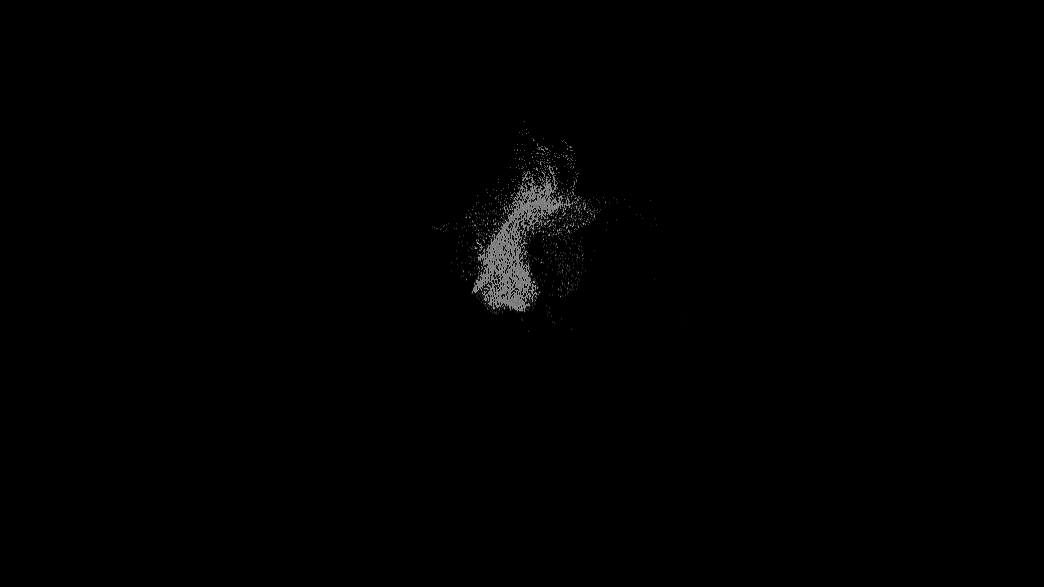
- Strength, Noise Size, Speed, Octaves, Roughness
- A shared Field block limits where it acts
- Found in the node graph under Particles → Effectors
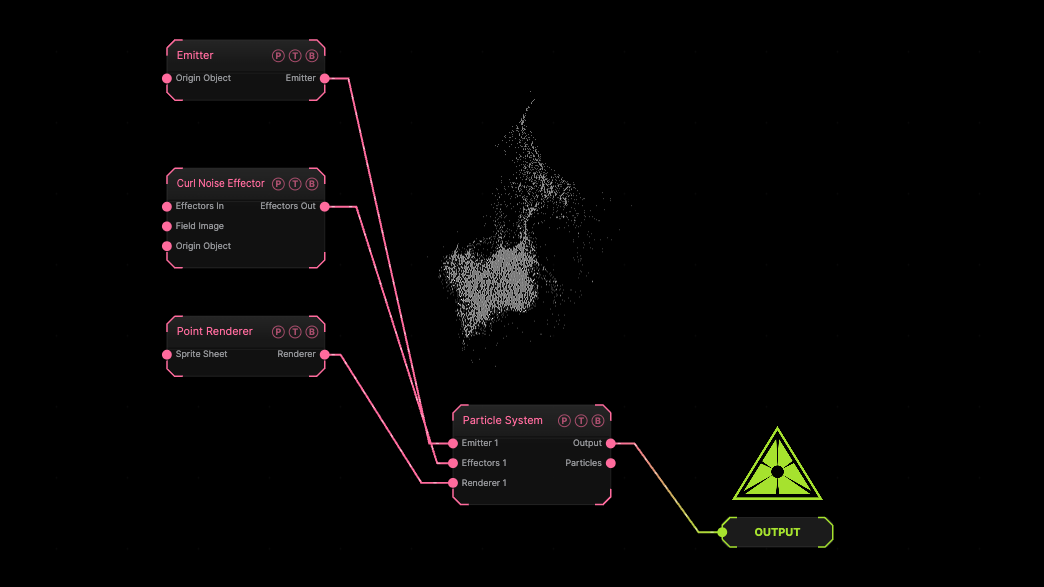
The image on the right is the example patch itself. Drag and drop it onto the app, or load it with File → Load, to open the full graph. A sphere emitter, a Point Renderer, and the default curl.
Inputs and outputs
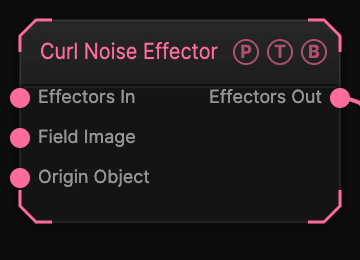
| Port | Type | Purpose |
|---|---|---|
| Effectors In | Effector | The previous effector in the chain, if any. |
| Field Image | Texture | A texture read by the Image field shape. |
| Origin Object | Surface | A Null to parent the effector to. |
| Effectors Out | Effector | Wire it into the next effector, or into the Particle System's Effectors port. |
Parameters
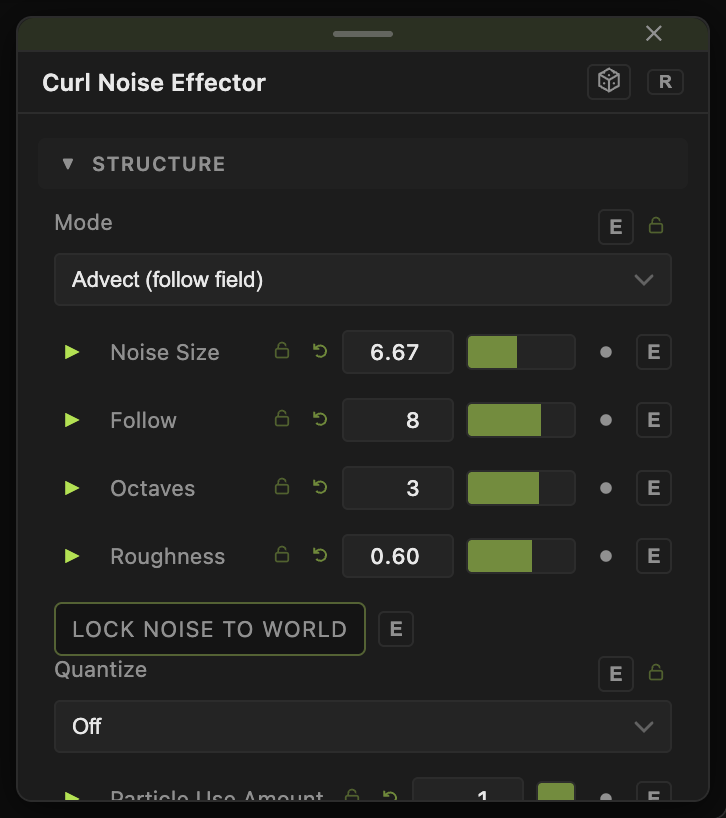
- Strength (0–20, default 2) — in Advect mode this is the travel speed.
- Noise Size (0.65–100, default 6.667) — the size of the eddies. Bigger values, bigger swirls.
- Speed (0–3, default 0.2) — how fast the field evolves.
- Octaves (1–4, default 3), Roughness (0–1, default 0.6).
- Field — Rebuilt (default) or Classic (pre-2026-09-03): the construction of the noise. Patches saved before the rebuild keep Classic.
- Mode — Advect (follow field) (default) steers velocity onto the field so particles ride its streamlines; Force (accelerate) treats the field as acceleration and scatters them.
- Follow (0.1–60, default 8) — how quickly Advect mode pulls velocity onto the field.
- Lock Noise To World (default off) — the noise stays fixed in space instead of moving with the effector.
- Quantize — Off (default), 90° Axes, or 90° + 45° snaps the motion to a lattice; Constant Speed and Hard Snap shape the snap.
- Particle Use Amount (0–1, default 1) — the share of particles this effector acts on. Two effectors with the same amount act on different particles.
- Speed Variance (0–4, default 0) and Speed Bias (−1 to 1, default 0) — scatter the force per particle.
Field
- Field (default off) — limits the effector to a region. Field Shape (Sphere, Box, Plane, Image), Field Size (default 3), Falloff (default 0.5), Inner Radius, Invert Field, Field Follows Mouse, and Image Channel for the Image shape. The Field Position / Heading / Pitch / Roll / Scale block places it.
Every slider has a per-parameter animation bar, so it can be animated, audio driven, or MIDI mapped.
Examples
Smoke — Noise Size 15, Strength 1, with a Drag Effector after it.
Sheets peeling off a mesh — a Mesh Emitter and this effector in Advect mode.
Troubleshooting
Nothing moves. The effector's Effectors Out must reach the Particle System's Effectors port, directly or through the last effector in a chain.
The pattern changed after opening an old patch — it kept Field Classic. Switch to Rebuilt to opt into the new construction.